Start with the honest numbers
Orly sits about 14 kilometres south of central Paris, much closer than Charles de Gaulle. Its terminals are grouped as Orly 1-2-3 and Orly 4. By road, the journey into Paris takes 25 to 45 minutes outside peak hours, and noticeably more on weekday mornings and evenings, when the A6 and the périphérique slow down.
As at Charles de Gaulle, the real difference between the options is not speed. It is what each one asks of you once you have landed: walking, carrying, queueing, or nothing at all. We compared the same options for the other airport in our CDG to Paris guide.
Metro line 14
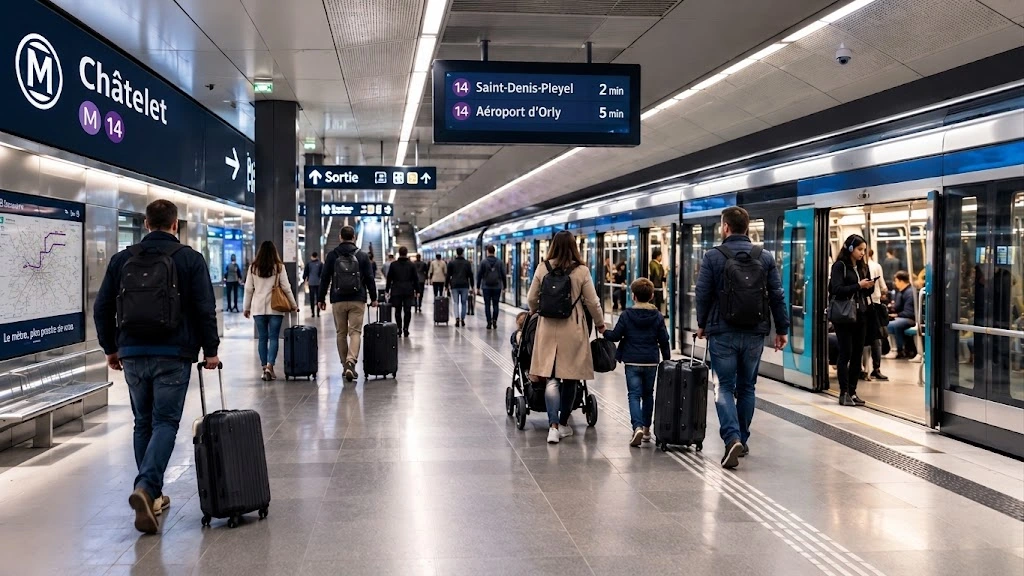
Since June 2024, the automatic metro line 14 runs directly from Orly into Paris, reaching Châtelet in around 25 minutes, with stops such as Gare de Lyon and Madeleine. It is now the fastest public transport option from the airport.
You need the Paris Region–Airports ticket, which costs €14 in 2026. It is digital only, loaded on a Navigo Easy pass or on the Île-de-France Mobilités app, and is also valid on the RER and Orlyval for two hours.
The limits are the usual ones: the metro is busy at rush hour, the stations are not designed for large suitcases, and the final leg from the station to your address is yours to manage. It is the right answer if you travel light and your hotel is near a line 14 station.
Orlyval and the RER B
The older route still exists: the Orlyval shuttle train links the terminals to Antony station, where you change to the RER B for central Paris. It is covered by the same €14 ticket.
With line 14 now running, Orlyval is mainly useful if your destination lies on the RER B in the south of the city, or towards the Latin Quarter. For most visitors, it means two trains and a change with luggage instead of one.
Note that the Orlybus, which ran between Orly and Denfert-Rochereau for decades, stopped in March 2025. Many guides and forums still recommend it.
The official taxi
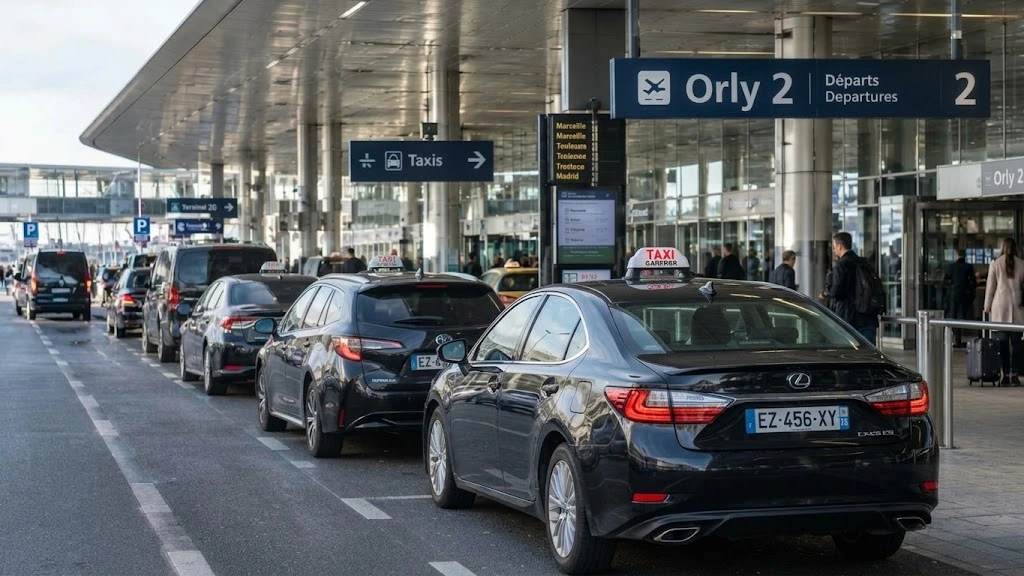
Paris taxis apply a flat fare between Orly and the city, set by prefectoral order: €36 to the Left Bank and €45 to the Right Bank in 2026, in either direction. The price does not change with traffic, and you cannot be taken the long way round. The flat fare applies to a direct journey only: ask for a stop on the way and the meter takes over.
The catch is the queue at the official rank, which can be long when several flights land together. Take a taxi only from the marked rank, and ignore anyone offering a ride inside the terminal.
Ride-hailing
Convenient in principle, unpredictable in practice. The fare is not fixed and rises with demand, which peaks exactly when several flights arrive at once. The pickup areas are some distance from the arrivals exit, and if your flight is delayed, your booking may be lost and rebooked at whatever the price is by then.
A private transfer
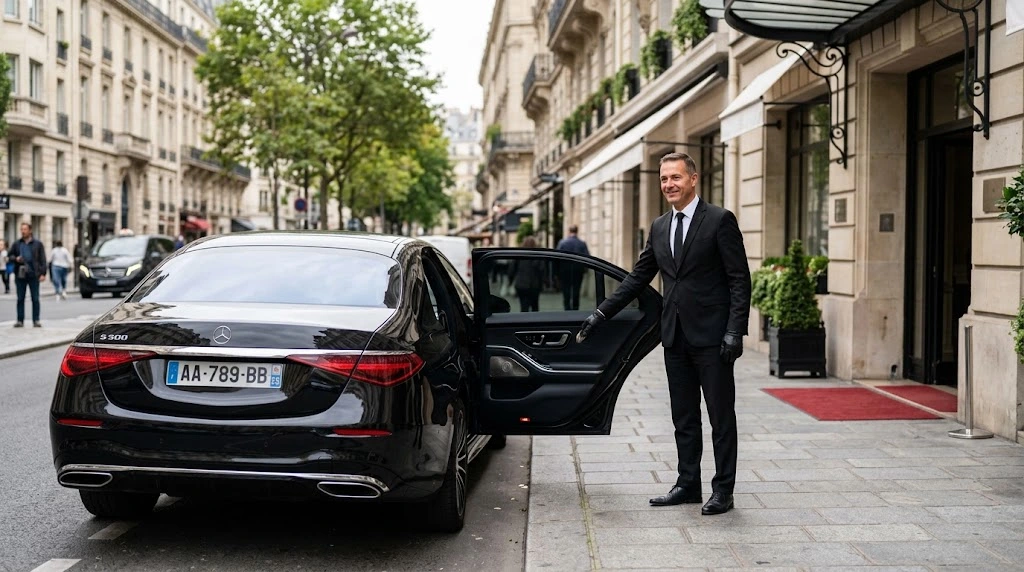
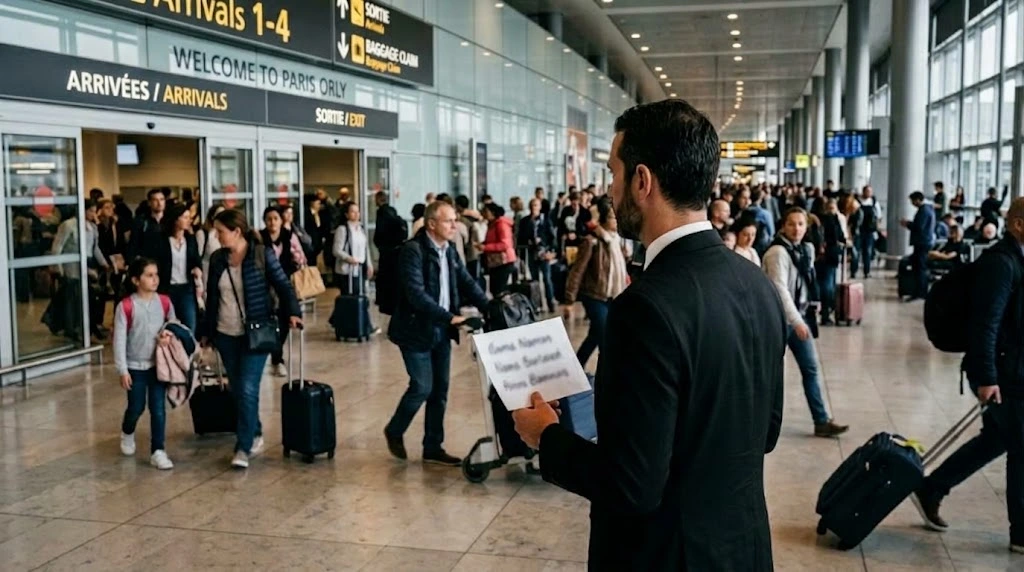
The fare is agreed in writing before you travel and does not move with traffic or time of day. Your chauffeur tracks the flight, so a delay or an early landing costs you nothing, and waits for you inside the terminal, at the exit your flight uses, with a name board. Luggage goes from the trolley to the boot, and child seats are fitted in advance if you tell us the ages.
It is not the cheapest option. It earns its cost in three situations: two or more passengers, where the price per person quickly approaches a taxi; real luggage, where the metro stops being practical; and a late or tiring arrival, when the last thing you want is a queue. For a fully escorted arrival, see our VIP Meet & Greet.
Which to choose
Alone, light luggage, hotel near line 14: take the metro.
One or two travellers, moderate luggage, no fixed appointment: the official taxi rank is fine, allow for the queue.
Family, groups or plenty of luggage: one vehicle, room for everyone, seats already fitted, nothing to work out after the flight. A V-Class takes seven passengers and their cases. This is where a private transfer makes the most sense.
Business travel: a fixed price, a chauffeur who tracks the flight and a quiet car to work in. And if you are wondering whether to tip at the end, the short answer is no.