The dates
The Automobile Club de l’Ouest has confirmed the 95th 24 Hours of Le Mans for 9 to 13 June 2027. As in every recent year, the week builds rather than begins: free practice and qualifying through Wednesday and Thursday, the Road to Le Mans support race and the drivers’ parade on the Friday, and the race starting at 16:00 on the Saturday and finishing at 16:00 on the Sunday.
Applying that pattern to 2027 puts the start on Saturday 12 June and the finish on Sunday 13 June. The ACO publishes the hour-by-hour timetable a few months out; treat the structure as reliable and the individual session times as provisional until it does.
One date is worth marking separately: the Test Day, usually held on a Sunday a fortnight or so before the race. It is a genuinely pleasant way to see the cars with a fraction of the crowd, and it is a single day trip from Paris rather than a weekend.
Getting to Le Mans from Paris
Le Mans sits about 210 kilometres south-west of Paris. By road it is the A11 more or less the whole way, and roughly two hours if nothing is happening. During race week something is always happening.
The TGV from Montparnasse reaches Le Mans in under an hour, which sounds decisive until you remember that the station is not the circuit. The Sarthe tramway runs a dedicated service towards the track during the event, but it ends when the crowd ends, and the crowd does not run at three in the morning. A train also fixes your departure hour in advance, which is precisely what a twenty-four-hour race makes impossible to predict.
Whichever way you arrive, the last stretch is the problem, not the first. Budget generously for it and you will be right more often than the map is.
Why the last two kilometres are the hard part
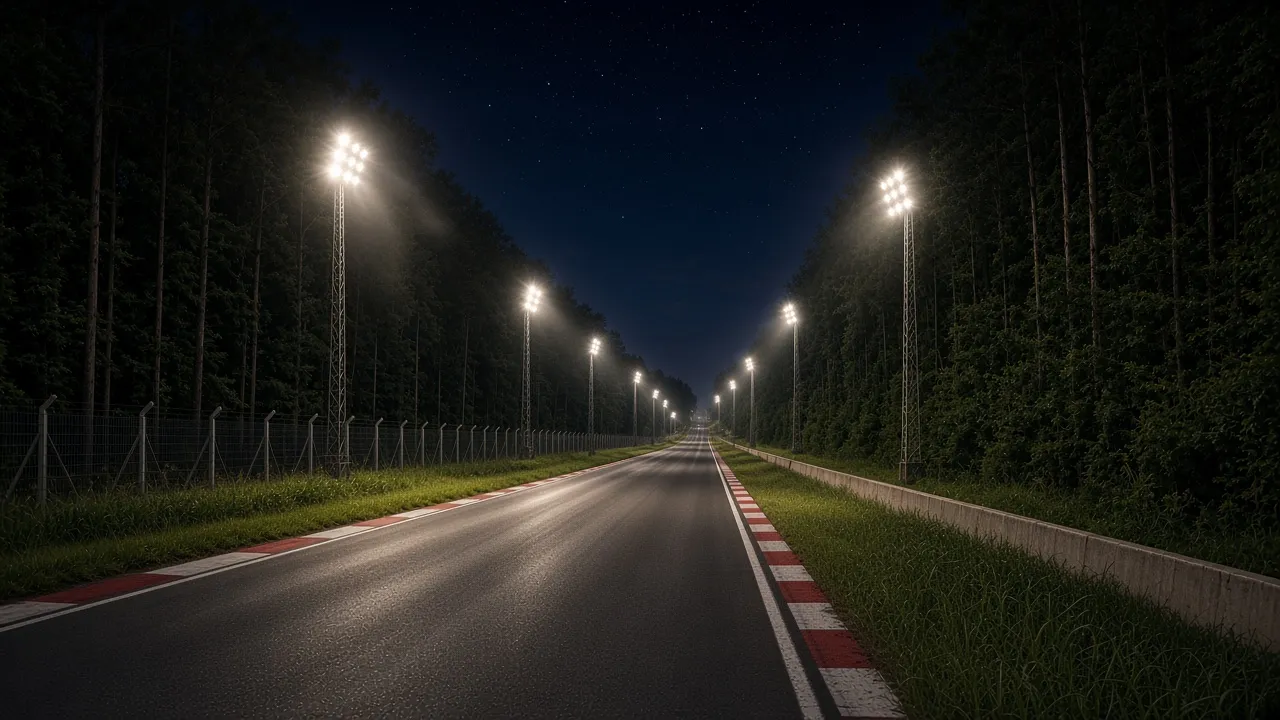
The Circuit de la Sarthe is 13.626 km long, one of the longest in the world, and only part of it is a permanent racing facility. The rest is ordinary public road for fifty weeks of the year. The Mulsanne straight is the D338; it once ran nearly six kilometres uninterrupted, and has been broken by two chicanes since 1990, when cars began passing 400 km/h.
That is the whole explanation for the access problem. The roads that would take you to the circuit are the circuit, and they close. Traffic is funnelled onto a handful of approaches serving a quarter of a million people, and which of those approaches works depends on the hour and on which gate your ticket opens.
Parking exists, in fields, at a distance, and it fills early. Plenty of visitors spend longer covering the final two kilometres than they spent covering the two hundred before them.
Where to watch
The main grandstands face the pits and the start-finish line, which gives you the start, the pit stops and the big screens. It is the safe choice and the expensive one.
The Porsche Curves, a fast sequence in the closing part of the lap, are where most seasoned visitors end up, particularly after dark. The Dunlop bridge and the Esses early in the lap give you cars braking hard from real speed. Arnage, at the end of the Mulsanne, is the slowest corner on the circuit and the one where you hear the gearboxes.
General admission lets you move between these, which is the best argument for it. The counter-argument is that moving between them on foot, across a 13-kilometre circuit, takes time you had planned to spend watching.
The night is the point
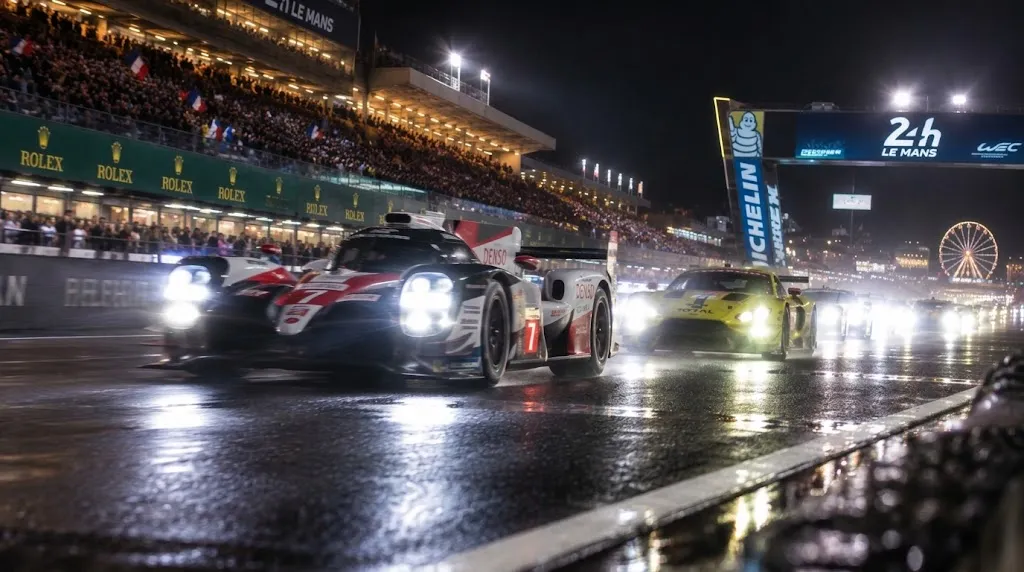
Ask anyone who goes every year what they remember and they will describe something that happened between midnight and five in the morning: brake discs glowing orange through the fencing, headlights strung out down the Mulsanne, the temperature dropping and the sound changing as the track cools.
It is also the hardest part to organise. Shuttles have stopped. Taxis are theoretical. Your hotel is probably not in Le Mans — accommodation across the Sarthe sells out close to a year in advance, and many visitors end up thirty or forty minutes out. And you have been awake since six.
This is the specific reason a car and chauffeur held by the day makes more sense here than almost anywhere else we drive. Not for the journey from Paris, which is easy, but for the one at 3am back to a hotel in a village whose name you have not yet learned to pronounce.

Planning the weekend
The order that works is: tickets, then accommodation, then transport. Hotels in and around Le Mans open their race-weekend bookings very early and are gone within weeks. If you are reading this in autumn for the following June, you are already later than ideal.
Decide next how many days you want. Friday to Sunday covers the parade, the race and the finish, and is what most visitors choose. Wednesday to Sunday adds qualifying, which is when the circuit is at its emptiest and the cars are at their fastest — the connoisseur’s option.
Then match the car to that. A weekend at Le Mans is not a transfer out and a transfer back; it is a car on standby for several consecutive days, which is a different booking and a different price. We have written it up as a Journey of its own, and we take a number of guests who fly into Charles de Gaulle on the Friday and are at the circuit in time for the parade.